Why You Need GSA SER Contextual Link Building Tutorial for Safe Link Building
GSA SER Contextual Backlinks
What Are GSA SER Contextual Backlinks?
Contextual backlinks are hyperlinks placed naturally within the body of a relevant piece of content, surrounded by text that gives them meaning. When you use GSA Search Engine Ranker (GSA SER), you can automate the creation of these links across a vast range of platforms. The tool identifies text-rich environments—like blog posts, forum threads, article directories, and social network pages—where your link can be embedded inside an actual article or comment so it appears editorially relevant. This is fundamentally different from isolated profile links or sidebar blasts because the link is backed by thematic content.
Why GSA SER Contextual Backlinks Matter in Modern SEO
Search engines value links that come from content deeply related to your niche. A contextual placement signals that your page is being referenced from a source that discusses similar topics, boosting topical authority. GSA SER automates the search for platforms that allow such insertions, from expired web 2.0 articles to niche-relevant forums. By using verified lists and carefully tuned project settings, you can generate a network of GSA SER contextual backlinks that support your tiered link building strategy. The result is a diversified backlink profile where a large portion of your links points from in-content citations, not random comment boxes or footers.
Key Mechanisms That Deliver Contextual Placements
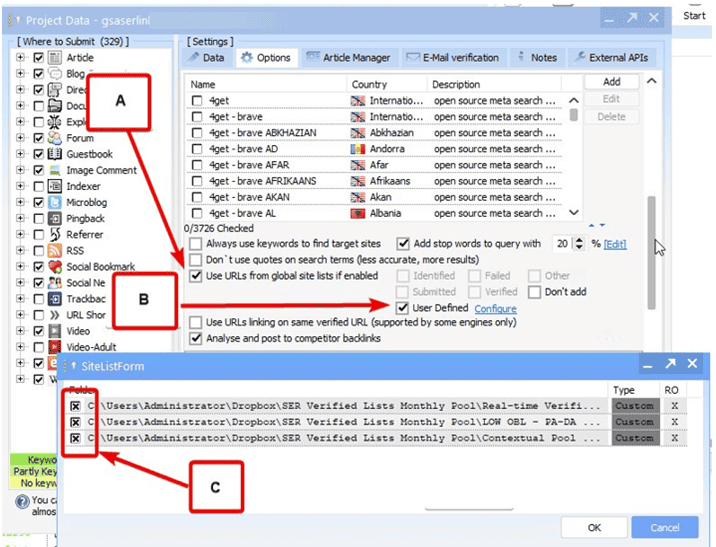
- Article scraping and spinning: GSA SER pulls content from scraped sources, rewrites it with spun syntax, and submits it to sites that accept guest articles or directory posts, often embedding your anchor within the article body.
- Forum and community posting: The tool can register on niche forums, find relevant threads, and post meaningful replies that contain your link seamlessly woven into the discussion.
- Web 2.0 post creation: It creates full blog posts on platforms like WordPress.com, Blogger, or Tumblr, where the anchor appears within a paragraph, surrounded by spun, readable text.
- Comment injection with contextual overdrive: Instead of a simple "nice post" comment, advanced configurations enable longer, article-like comments that read like a guest contribution, placing the link inside a contextual block.
How to Build an Effective GSA SER Contextual Backlinks Campaign
Running a successful contextual campaign requires more than just hitting “start.†You need to structure your project so that every link is born inside a relevant content frame. Below is a step-by-step approach to maximize quality while keeping automation high.
1. Curate Premium, Relevant Target Lists
Stop using massive, unverified global site lists. Instead, build custom lists of platforms that accept articles, quality forum registrations, and expired Web 2.0 read more properties with existing authority. Use platforms like ScrapeBox to harvest URLs with your niche keywords, then filter them through GSA SER’s internal verifier. This ensures your GSA SER contextual backlinks will land on sites that already talk about topics related to yours.
2. Master Content and Anchor Text Settings
Within the project options, go to the “Article Manager†and “Content Manager.†Populate them with high-quality, human-readable spun articles that include your links naturally in the second or third paragraph. For anchors, avoid a single aggressive keyword. Use a healthy mix: 40% branded, 30% generic URL, 20% partial-match phrases, and only 10% exact-match anchors. GSA SER’s syntax lets you insert anchors as %link% inside an article, ensuring the link appears mid-content.
3. Enable Only Engines That Support Contextual Submission
Not all engines are equal. Prioritize these for true contextual power:
- Article Directory engines: Post articles with an author bio or in-body link.
- Web 2.0 engines: Create entire subdomains with multi-paragraph posts.
- Forum engines: Set up profiles, search for niche threads, and reply with spun paragraphs.
- Social Network engines: Some allow blog-style posts or long status updates with embedded links.
De-select engines that only produce profile fields or low-quality guestbooks unless they serve a specific tier-2 purpose.
4. Fine-Tune the “Contextual Link†Option and Filters
Inside GSA SER, many engines have a “Contextual Link†checkbox (e.g., under social bookmarking or Web 2.0 engines). Activate it. Additionally, set PR/DA/TF filters to avoid no-metric spam. Use the “skip sites with more than X outbound links†rule so your contextual link isn’t buried in a link farm. Finally, schedule posts to look natural, with delays ranging from 30 seconds to 5 minutes between submissions.
Common Myths About GSA SER Contextual Backlinks
There’s a lot of misinformation floating around. Let’s clear it up.
- Myth: GSA SER can only produce spammy, non-contextual links.
Truth: When configured correctly with spun content and quality platforms, it creates genuine article-style placements that pass link equity contextually. - Myth: Contextual links built via automation are always toxic.
Truth: Toxicity comes from footprints, over-optimized anchors, and trash content. Properly masked campaigns with unique, readable text can blend naturally. - Myth: You need thousands of contextual links to see results.
Truth: A few hundred well-placed, niche-relevant contextual backlinks from diverse, aged domains often outperform tens of thousands of comment spam.
Best Practices to Keep Your GSA SER Contextual Backlinks White-Hat-Friendly
Automation doesn’t have to mean black-hat. Use these practices to maintain a clean profile that won’t trigger manual actions.
- Always buffer with a buffer site tier. Never point GSA SER contextual backlinks directly at your money site. Instead, send them to a tier-1 buffer—like a high-quality guest post or a personal blog you control. The contextual links power the tier-1 properties, which then link to your main site.
- Invest in private proxies and captcha solving. Footprints are minimized when each post appears to come from different IPs and solves captchas smoothly.
- Rotate content heavily. Use multi-level spinning with hundreds of sentence variations to ensure every posted article is unique enough to pass duplicate checks.
- Drip-feed over weeks, not hours. A natural velocity curve prevents patterns. Start with a few links per day and gradually increase.
- Constantly prune dead or penalized targets. Run periodic checks with GSA’s “verify†feature and remove sites that have turned into 404 errors or now carry malware.
Frequently Asked Questions About GSA SER Contextual Backlinks
Are GSA SER contextual backlinks safe for Google rankings?
They can be safe if used as part of a tiered link-building strategy and pointed to buffer pages. Direct contextual backlinks from automated sources to your money site carry inherent risk. However, when you insulate your main domain with a well-managed tier-1 layer and focus on relevance, the risk is significantly reduced while authority still flows through.
What is the difference between contextual backlinks and other GSA SER links?
Contextual backlinks appear within article content, surrounded by text that provides topic signals. Other GSA SER links—like those from profile pages, blog comments without meaningful text, or directory listings—lack this in-content placement. Contextual links pass more relevant link juice and are favored by modern algorithms.
How long does it take for GSA SER contextual backlinks to show an effect?
Typically, you’ll see movement in tier-1 buffer pages within 4–6 weeks as the contextual links get indexed and start passing authority. Your main site might feel the impact after 2–3 months, depending on the buffer site’s authority and the quality of the links supporting it.
Can I use GSA SER contextual backlinks for a local business?
Yes, but with extra caution. Local citations and genuine local-relevant content are crucial. You can use GSA SER to build contextual backlinks to a local landing page only if you spin content that mentions specific cities, neighborhoods, and service keywords in a natural way. Integrate with local forum profiles and neighborhood blogs for a smoother fit.
Do I need to manually write content for every contextual backlink?
No, but you do need to prepare a robust spun article database. Write 5–10 high-quality, 500-word articles, then spin them at the sentence and paragraph level using tools like WordAi or Spin Rewriter. GSA SER will mix and match these to create thousands of unique versions for contextual placements.
Final Thoughts on Using GSA SER Contextual Backlinks Strategically
GSA SER contextual backlinks remain a powerful weapon in the SEO arsenal when wielded intelligently. The tool’s ability to create content-rich, in-body citations at scale can accelerate your link velocity and reinforce your tiered pyramid. The line between spam and smart automation lies in your configuration, content quality, and targeting discipline. Spend time building resource lists, tweaking anchor ratios, and shielding your money site. With these guardrails, you can enjoy the amplification effect of contextual links without putting your primary project at risk.